Risk-to-Reward Ratio in Forex: How to Calculate It and Use It Properly
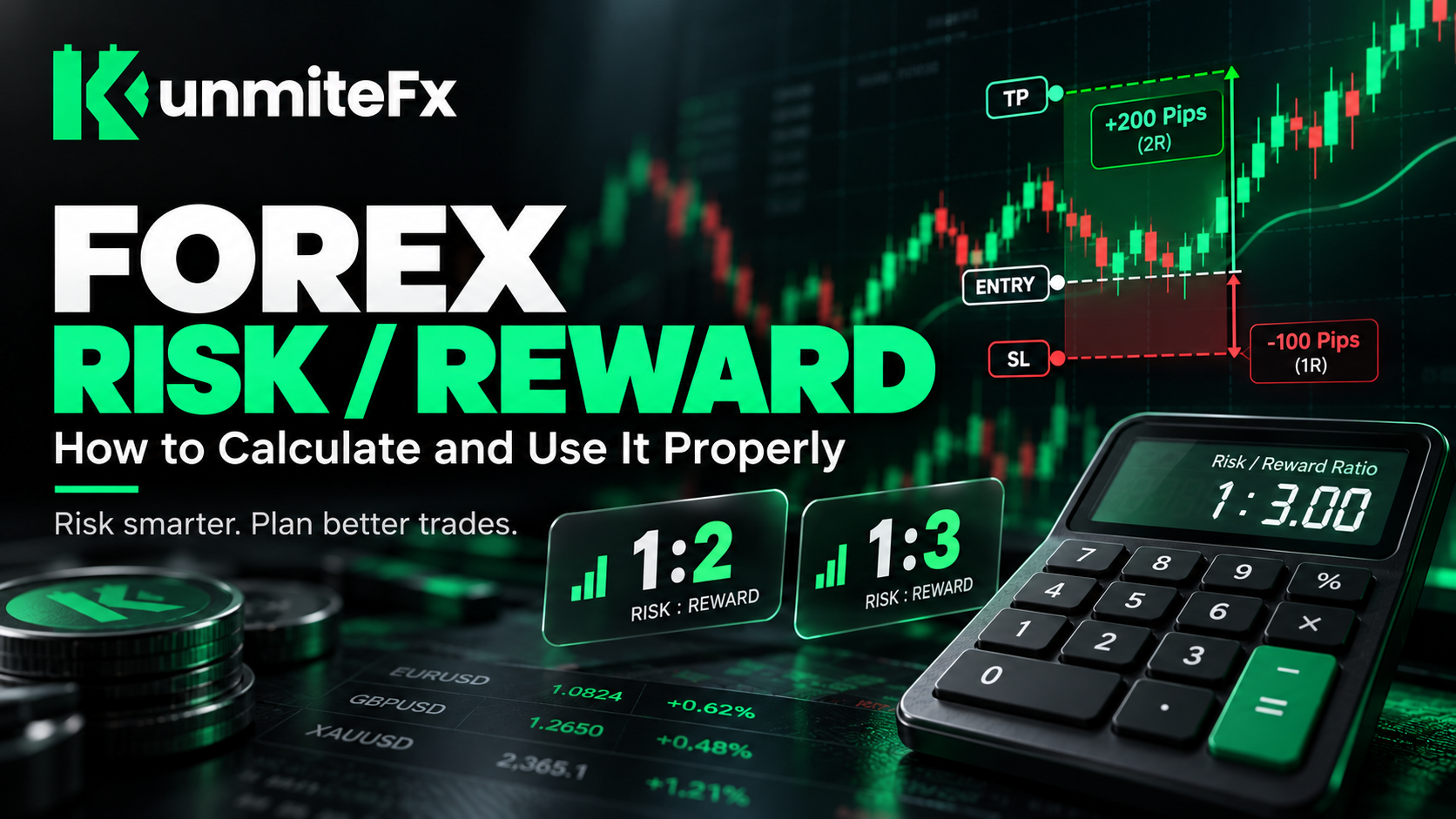
Risk-to-Reward Ratio in Forex: How to Calculate It and Use It Properly
A trader can be wrong several times and still remain profitable.
Another trader can win more trades than they lose and still lose money overall.
The difference often comes down to one important concept:
risk-to-reward ratio.
Risk-to-reward ratio helps you compare how much money you are prepared to lose on a trade with how much you could potentially make if the trade reaches your target.
It is closely connected to stop-loss placement, take-profit targets, position sizing and win rate.
Understanding how these pieces work together can help you evaluate trades more logically instead of focusing only on whether an entry looks attractive.
What Is Risk-to-Reward Ratio?
Risk-to-reward ratio compares the potential loss on a trade with its potential profit.
For example, suppose you enter a trade where:
your maximum planned loss is $50
your potential profit is $100
Your risk-to-reward ratio is:
1:2
This means that for every $1 you are prepared to risk, you are targeting $2 in potential profit.
Similarly:
risk $50 to potentially make $50 = 1:1
risk $50 to potentially make $100 = 1:2
risk $50 to potentially make $150 = 1:3
The same principle applies whether your risk is measured in dollars, pounds, pips or another unit.
How to Calculate Risk-to-Reward Ratio
The basic calculation is:
Risk-to-Reward Ratio = Potential Loss : Potential Profit
You can calculate it using the distance between:
your entry and stop loss
your entry and take-profit target
For example:
Entry price: 1.1000
Stop loss: 1.0980
Take profit: 1.1040
The stop loss is:
20 pips
The potential profit is:
40 pips
Therefore:
20 : 40 = 1 : 2
The trade has a 1:2 risk-to-reward ratio.
Example: 1:3 Risk-to-Reward Trade
Imagine a trader enters EUR/USD and decides that the trade becomes invalid if price moves 25 pips against the position.
The trader therefore sets:
Stop loss: 25 pips
Take profit: 75 pips
The calculation becomes:
25 : 75
Divide both numbers by 25:
1 : 3
Therefore, the trader is risking one unit to potentially make three units.
If the trader risks $20 on the trade, the potential profit would be approximately:
$60
But this does not mean the trader should automatically take the trade.
The target still needs to make sense based on the market structure.
A Bigger Risk-to-Reward Ratio Is Not Automatically Better
It can be tempting to assume that a 1:5 trade is always better than a 1:2 trade.
That is not necessarily true.
Suppose you place a stop loss 20 pips away and choose a take-profit target 100 pips away simply because you want a 1:5 ratio.
The calculation may look attractive, but if the market is unlikely to travel 100 pips before reversing, the target may be unrealistic.
A higher reward target generally becomes harder to reach.
Also note that larger reward targets may result in fewer winning trades because more distant targets are naturally harder for price to reach.
The goal is therefore not to create the largest ratio possible.
The goal is to find a realistic relationship between risk and potential reward.
Risk-to-Reward Ratio and Win Rate
Risk-to-reward ratio becomes much more useful when combined with win rate.
Your win rate tells you how often your trades are profitable.
For example, imagine 10 trades using a 1:2 risk-to-reward ratio.
You risk $10 on each trade.
Suppose:
4 trades win
6 trades lose
Winning trades:
4 × $20 = $80
Losing trades:
6 × $10 = $60
The result before trading costs would be:
$80 − $60 = $20 profit
Even though the trader lost more trades than they won, the winning trades were larger than the losing trades.
That is why win rate alone does not tell the full story.
Break-Even Win Rate
Different risk-to-reward ratios require different break-even win rates.
Ignoring trading costs, the approximate formula is:
Break-Even Win Rate = 1 ÷ (1 + Reward-to-Risk Ratio)
For a 1:1 setup:
1 ÷ (1 + 1) = 50%
For a 1:2 setup:
1 ÷ (1 + 2) = 33.3%
For a 1:3 setup:
1 ÷ (1 + 3) = 25%
So theoretically, a trader using a consistent 1:3 setup could break even with a lower win rate than a trader using 1:1 setups, before spreads, commissions, slippage and other costs are considered. Similar break-even relationships are described in current forex education resources.
Risk-to-Reward Ratio Does Not Replace Position Sizing
This is an important distinction.
Risk-to-reward ratio tells you the relationship between potential loss and potential gain.
It does not tell you how much money you should risk.
A trader could have a 1:3 setup but still risk far too much of their account.
For example:
Trader A:
Account balance: $1,000
Risk per trade: $10
Risk-to-reward: 1:3
Trader B:
Account balance: $1,000
Risk per trade: $300
Risk-to-reward: 1:3
Both traders technically have the same risk-to-reward ratio.
But Trader B is exposing a much larger percentage of the account to one trade.
This is why risk-to-reward should be used together with proper position sizing.
If you have not read our position-sizing guide yet, read:
Forex Position Size Calculator: How to Calculate Lot Size and Risk Per Trade
You can also use the KunmiteFX Position Calculator to estimate an appropriate trade size based on your planned risk and stop-loss distance.
Stop Loss Should Come Before the Ratio
One of the most common mistakes is deciding:
“I only take 1:3 trades.”
and then forcing the stop loss and take profit to fit that number.
A better process is:
Identify the trade setup.
Decide where the trade idea becomes invalid.
Place the stop loss around that invalidation point.
Identify a realistic profit target.
Calculate the resulting risk-to-reward ratio.
Decide whether the trade fits your trading plan.
The market structure should help determine the stop and target.
The ratio should help you evaluate the trade afterwards.
Example Using Market Structure
Suppose EUR/USD is trading at:
1.0850
A trader believes price could move higher.
Recent support is around:
1.0820
A logical stop may therefore be around:
1.0815
Risk:
35 pips
The next major resistance level is around:
1.0920
Potential reward:
70 pips
Risk-to-reward:
35 : 70 = 1 : 2
This setup provides approximately a 1:2 ratio.
Now the trader can decide whether that ratio matches their strategy.
Common Risk-to-Reward Mistakes
1. Moving the Stop Loss Further Away
A trader enters a position with a planned $20 risk.
Price begins moving against the trade.
Instead of accepting the loss, the trader moves the stop farther away.
The original risk calculation is now meaningless because the potential loss has increased.
2. Moving the Take Profit Too Close
Sometimes traders become nervous when a position moves into profit.
A planned 1:3 setup may suddenly become a 1:0.5 trade because the trader closes too early.
Repeatedly doing this can change the mathematics of the entire trading strategy.
3. Choosing Arbitrary Targets
A trader may force every setup into a 1:3 ratio even when market structure does not support the target.
A good-looking number does not make an unrealistic target more achievable.
4. Ignoring Trading Costs
Spreads, commissions and slippage can reduce actual returns.
This is especially important when trading very small targets.
5. Ignoring Position Size
A trader may focus heavily on risk-to-reward while still risking an excessive percentage of the account.
Risk-to-reward and position sizing solve different problems.
Both matter.
Risk-to-Reward and Trading Expectancy
Another useful concept is expectancy.
Expectancy estimates how much a strategy might make or lose on average over many trades.
A simplified formula is:
Expectancy = (Win Rate × Average Win) − (Loss Rate × Average Loss)
Imagine:
Win rate: 40%
Loss rate: 60%
Average win: $20
Average loss: $10
The calculation becomes:
(0.40 × $20) − (0.60 × $10)
$8 − $6 = $2
The strategy would have a positive expectancy of approximately $2 per trade before trading costs.
This shows why a trader does not necessarily need an extremely high win rate.
The relationship between average wins and average losses also matters.
Should Every Trader Use 1:2?
There is no universal risk-to-reward ratio that works for every trader or every strategy.
Different systems may naturally produce different combinations of:
win rate
average profit
average loss
trade frequency
market conditions
A high-frequency strategy may behave differently from a swing-trading strategy.
Also notes that there is no single “golden” ratio suitable for every trader.
Rather than blindly copying a specific number, traders should study the historical performance of their strategy.
A Simple Pre-Trade Risk Checklist
Before entering a trade, ask:
Where is my entry?
Where is my stop loss?
Where is my take-profit target?
How many pips am I risking?
How many pips could I potentially gain?
What is my risk-to-reward ratio?
How much money am I risking?
What percentage of my account is at risk?
Does the target make sense based on market structure?
Does this trade follow my trading plan?
If you cannot answer those questions before entering, your risk may not be clearly defined.
Final Thoughts
Risk-to-reward ratio is one of the simplest ways to evaluate the relationship between potential loss and potential profit.
But it should never be used alone.
A strong risk-management process combines:
stop-loss placement + position sizing + risk-to-reward + win rate + discipline
Instead of asking only:
“Will this trade win?”
consider asking:
“If I am wrong, how much will I lose, and if I am right, how much could I reasonably make?”
That question encourages a much more structured approach to trading risk.
Use the KunmiteFX Position Calculator to calculate your position size before entering a trade, and continue building a consistent risk-management process around every setup.
Continue building your trading knowledge with KunmiteFX educational tools and resources.