How to Create a Forex Trading Plan: A Step-by-Step Guide for Beginners
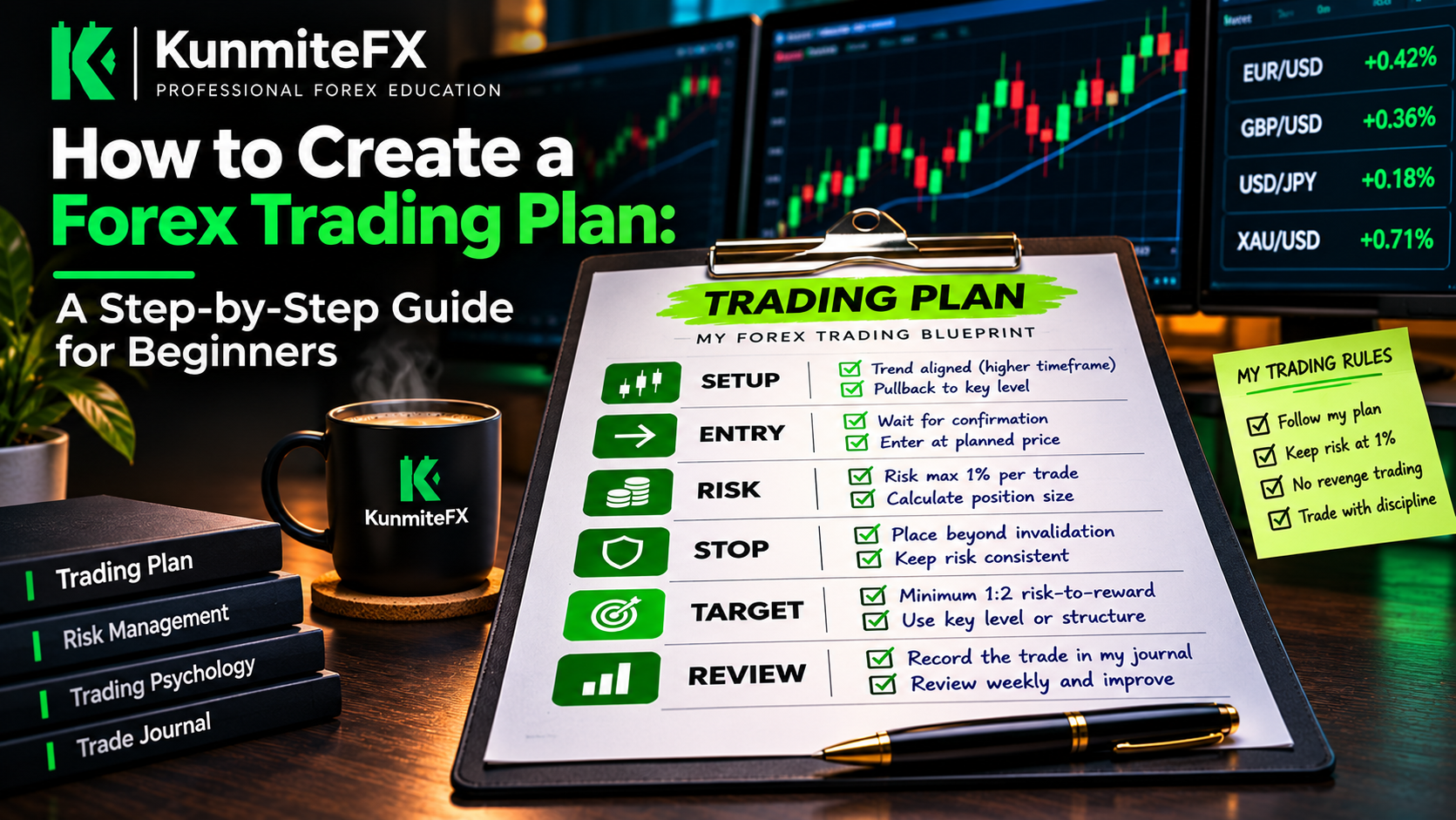
How to Create a Forex Trading Plan: A Step-by-Step Guide for Beginners
Many new traders spend most of their time searching for strategies.
They study indicators.
They watch chart analysis.
They learn candlestick patterns.
They look for entries.
But one important part of trading is often ignored:
the trading plan.
A trading plan is the written structure that tells you what you trade, when you trade, how you enter, how much you risk and what you do when a trade wins or loses.
Without a plan, trading decisions can change from one moment to the next.
One day you risk 1%.
The next day you risk 5%.
One trade has a stop loss.
Another does not.
You wait patiently for one setup, then chase the next move because you are afraid of missing out.
A trading plan helps reduce that inconsistency.
It does not guarantee profitable results.
But it gives you a framework for making decisions before emotions become involved.
What Is a Forex Trading Plan?
A forex trading plan is a written set of rules that guides your trading decisions.
It can define:
which markets you trade
which trading sessions you use
what setups you look for
your entry conditions
your stop-loss rules
your position-sizing method
your risk per trade
your profit-taking rules
your maximum daily loss
when you stop trading
how you review your performance
Think of it as an operating manual for your trading.
The goal is to avoid making every decision from scratch while the market is moving.
Why Is a Trading Plan Important?
Markets create pressure.
Price can move quickly.
A setup may appear suddenly.
A loss may create frustration.
A winning streak may create overconfidence.
If you have no predetermined rules, emotions can influence your decisions.
A plan can help answer questions such as:
Should I enter this trade?
How much should I risk?
Where should my stop be?
Should I continue trading after two losses?
Should I increase my lot size?
Instead of answering these questions emotionally, you can return to the rules you created in advance.
Trading Plan vs Trading Strategy
These two terms are related but not identical.
A trading strategy explains how you identify trading opportunities.
For example:
Buy when price returns to support, market structure remains bullish and confirmation appears on a lower timeframe.
A trading plan is broader.
It includes the strategy but also covers:
risk
trading schedule
position sizing
psychology
daily limits
review process
Your strategy tells you what setup to trade.
Your trading plan tells you how you operate as a trader.
Step 1: Define Your Trading Goals
Before choosing indicators or markets, decide what you are actually trying to achieve.
Avoid vague goals such as:
“I want to make a lot of money.”
Instead, focus on goals you can control.
For example:
Follow my trading plan on at least 90% of trades.
Risk no more than 1% per trade.
Complete a journal entry after every trade.
Avoid revenge trading for the entire month.
Process-based goals are useful because you can measure them even when market results are uncertain.
Step 2: Decide Which Markets You Will Trade
Do not assume you need to trade everything.
Some traders focus on a few forex pairs.
For example:
EUR/USD
GBP/USD
USD/JPY
Others may also trade:
gold
indices
crypto
Your trading plan should state which markets are allowed.
This can help reduce random market switching.
For example:
I will trade EUR/USD, GBP/USD and XAU/USD only.
A smaller watchlist can make it easier to understand how specific markets behave.
Step 3: Define Your Trading Session
Forex operates across multiple major sessions.
These include:
Asian session
London session
New York session
Different strategies may perform differently at different times.
Your trading plan should define when you are allowed to trade.
For example:
I will trade only during the London session and the London-New York overlap.
This helps prevent trading simply because you are bored or because the platform is open.
Step 4: Define Your Setup
This is one of the most important parts of the plan.
Your setup should be specific enough that you can identify whether a trade qualifies.
For example:
Trend must be bullish on the higher timeframe.
Price must return to a predefined support zone.
Lower timeframe must show bullish confirmation.
Entry must occur only after confirmation closes.
This is much stronger than:
Buy when the chart looks bullish.
The more clearly your setup is defined, the easier it becomes to measure whether you followed it.
Step 5: Define Your Entry Rules
Write exactly what needs to happen before you enter.
For example:
Entry Checklist
Higher-timeframe direction identified
Key level marked
Price reaches the level
Confirmation appears
Stop-loss location is clear
Risk-to-reward meets minimum requirement
No major news event is imminent
If one required condition is missing, the trade is skipped.
This can help reduce impulsive entries.
Step 6: Define Your Stop-Loss Rule
A stop loss should not be placed randomly.
Your trading plan should explain where a trade becomes invalid.
For example:
My stop loss must be placed beyond the market structure that invalidates the setup.
Avoid rules such as:
Always use a 10-pip stop.
A fixed number of pips may not make sense in every market environment.
The better approach is usually:
Determine the logical stop first.
Then calculate the appropriate position size.
Step 7: Define Your Risk Per Trade
Your plan should clearly state your maximum risk.
For example:
Maximum risk per trade: 1% of account equity.
Or:
Maximum risk per trade: 0.5%.
The exact number depends on your circumstances and strategy.
There is no universal percentage that guarantees success.
The important part is consistency.
If your plan says 1%, you should not suddenly risk 5% because you feel confident.
Step 8: Calculate Position Size
Once your risk percentage and stop distance are known, calculate position size.
The general relationship is:
Position Size = Risk Amount ÷ (Stop Distance × Pip Value)
For example:
Account balance:
$5,000
Risk:
1%
Risk amount:
$50
Stop loss:
25 pips
The position size should be calculated so that approximately 25 pips against you equals about $50.
You can use the KunmiteFX Position Calculator to help estimate this before entering a trade.
Step 9: Define Your Minimum Risk-to-Reward
Your plan may include a minimum acceptable risk-to-reward ratio.
For example:
I will not enter trades offering less than 1:2 risk-to-reward.
That means if you risk:
$50
the planned potential reward should be approximately:
$100
But remember:
A high risk-to-reward ratio does not automatically make a trade good.
The target still needs to be realistic.
Step 10: Define Your Take-Profit Rules
Your trading plan should state how you manage winning trades.
Possible methods include:
fixed target
previous support/resistance
partial profit taking
trailing stop
structure-based exit
For example:
Primary target will be the next major resistance level, provided it offers at least 1:2 risk-to-reward.
This reduces the temptation to change targets emotionally while the trade is open.
Step 11: Define Maximum Daily Risk
Risk per trade is important.
But total daily risk matters too.
Suppose you risk:
1% per trade
and lose five trades in one day.
That could represent significant drawdown.
A trading plan can include a daily limit.
For example:
Stop trading after 2 losing trades.
Or:
Stop trading if daily loss reaches 2%.
The exact rule depends on your strategy.
The principle is simple:
Do not allow one emotional day to cause unlimited damage.
Step 12: Define Maximum Open Risk
If you have multiple trades open at the same time, calculate total exposure.
For example:
Trade 1:
1% risk
Trade 2:
1% risk
Trade 3:
1% risk
Your combined exposure could approach:
3%
If those positions are correlated, they may all move against you together.
Your trading plan can state:
Maximum total open risk: 2%.
This creates a portfolio-level limit.
Step 13: Create Rules for Losing Streaks
Losing streaks are normal.
Your plan should explain what happens when they occur.
For example:
After three consecutive losses, stop trading for the day.
Or:
If account drawdown reaches 5%, reduce risk from 1% to 0.5%.
Or:
If drawdown reaches 10%, pause live trading and review the strategy.
These rules should be created while you are calm.
Do not wait until the drawdown happens.
Step 14: Create Rules for Winning Streaks
Winning streaks can also create problems.
A trader may become overconfident and increase position size.
Your plan can include:
Risk does not increase after winning trades unless the account balance changes enough to justify a recalculation.
This keeps risk consistent.
Winning several trades does not mean the next trade cannot lose.
Step 15: Define Your News Rules
Major economic events can create extreme volatility.
Your trading plan should state whether you trade around major news.
For example:
No new trades 30 minutes before high-impact economic announcements.
Events may include:
interest-rate decisions
inflation reports
employment data
central-bank speeches
The exact rule depends on your strategy.
But it should be written down.
Step 16: Define When You Should Not Trade
A strong trading plan should also define situations where you do nothing.
For example:
Do not trade when:
tired
angry
distracted
rushing
trying to recover a loss
major news is approaching
setup is incomplete
maximum daily loss reached
Sometimes the best trade is no trade.
Step 17: Create a Pre-Trade Checklist
Before entering any position, ask:
Does this match my strategy?
Is the market within my approved trading hours?
Where is the stop?
What is my risk percentage?
What is my position size?
What is my target?
What is my risk-to-reward?
Is major news approaching?
Am I calm?
Am I entering because of my plan or because of FOMO?
If you cannot answer these questions clearly, you may not be ready to enter.
Step 18: Create a Post-Trade Review
After every trade, record:
result
R-multiple
whether the setup was valid
whether risk was correct
whether rules were followed
emotional state
mistakes
lessons
This connects your trading plan with your trading journal.
Step 19: Review Your Plan Weekly
At the end of each week, ask:
Did I follow my trading hours?
Did I respect risk limits?
Did I revenge trade?
Did I enter without confirmation?
Did I move stops?
Which setup performed best?
What was my largest mistake?
What should I improve next week?
Your trading plan should evolve based on data.
But changes should be deliberate.
Step 20: Review Your Plan Monthly
At the end of the month, review:
total trades
win rate
average R
drawdown
rule-following percentage
best setup
weakest setup
psychological mistakes
session performance
pair performance
Then decide whether any rules need adjustment.
Do not rewrite your strategy based on one bad day.
Use a reasonable sample of trades.
Example of a Simple Forex Trading Plan
Here is a simplified example.
Markets
EUR/USD and GBP/USD only.
Trading Hours
London session.
Setup
Trend continuation after a pullback to support/resistance.
Entry
Enter only after lower-timeframe confirmation.
Risk
Maximum:
1% per trade
Stop Loss
Beyond invalidation structure.
Minimum Risk-to-Reward
1:2
Maximum Daily Loss
2%
Maximum Open Risk
2%
News Rule
No new trades 30 minutes before major economic releases.
Losing Streak Rule
Stop after two consecutive losses.
Journal
Every trade must be recorded before another trade is taken.
This plan is simple.
But it creates structure.
Your Trading Plan Should Match Your Personality
Not every plan should be identical.
Some traders prefer:
fewer trades
larger timeframes
slower decision-making
Others may prefer:
shorter timeframes
more frequent setups
A plan should be realistic for your schedule and personality.
If you work a full-time job, a strategy requiring you to watch charts for eight hours every day may not be practical.
A plan you cannot follow is not useful.
Avoid Making the Plan Too Complicated
A trading plan does not need to be 50 pages.
Start with the essentials.
Your plan should answer:
What do I trade?
When do I trade?
What setup do I trade?
How much do I risk?
Where is my stop?
Where is my target?
When do I stop trading?
How do I review performance?
If those rules are clear, you already have a solid foundation.
Do Not Change Rules Mid-Trade
One of the biggest benefits of a written trading plan is having a reference point.
Suppose your stop is:
30 pips
Price moves against you.
You become nervous.
You decide to move the stop to:
60 pips
You have now changed the financial risk after entering.
The original plan no longer applies.
Unless your strategy specifically allows stop adjustments, this kind of decision can undermine risk management.
Trading Plans Reduce Decision Fatigue
Markets present constant information.
Every candle can create another decision.
Should I enter?
Should I exit?
Should I add?
Should I move the stop?
Should I take profit?
A written plan reduces the number of decisions you need to improvise.
The more important decisions you make beforehand, the less mental pressure you face while the market is moving.
A Trading Plan Does Not Guarantee Profit
This is important.
A trading plan can improve structure.
It cannot make an unprofitable strategy profitable by itself.
It cannot prevent market losses.
It cannot predict the future.
The goal is consistency.
A plan helps you determine whether poor results are caused by:
the strategy
or:
failure to follow the strategy
Without written rules, that distinction can be difficult to make.
The KunmiteFX Trading Framework
The KunmiteFX educational framework now connects several important concepts:
Trading Plan
defines the overall rules.
Trading Strategy
defines the setup.
Risk Per Trade
determines financial exposure.
Stop Loss
defines invalidation.
Position Size
adjusts the trade to your risk.
Risk-to-Reward
compares potential loss and potential profit.
Trading Psychology
helps you manage emotional decisions.
Trading Journal
records what actually happened.
The complete process becomes:
Plan → Analyze → Calculate Risk → Enter → Manage → Record → Review → Improve
Download the Free KunmiteFX Forex Trading Plan Template
You do not need to build your plan from a blank page.
We created the:
KunmiteFX Forex Trading Plan Template
It includes sections for:
trading goals
approved markets
trading sessions
setup rules
entry conditions
stop-loss rules
risk per trade
maximum daily loss
take-profit rules
news rules
psychology rules
weekly review
performance review
You can download it free from the KunmiteFX Free Resources page.
Use it as a starting point and adapt it to your own strategy and circumstances.
Final Thoughts
A trading plan cannot remove uncertainty from forex trading.
But it can remove unnecessary uncertainty from your own decisions.
Before the market opens, you should already know:
what you trade
when you trade
what setup you need
how much you risk
where you exit
when you stop trading
This allows you to evaluate yourself based on execution rather than emotion.
The objective is not to predict every market move.
The objective is to create a repeatable process.
When you have a plan, every trade becomes part of a larger system rather than an isolated decision.
And after every trading week, ask yourself:
Did I trade my plan—or did I trade my emotions?
Continue building your trading knowledge with KunmiteFX educational tools and resources.