Forex Trading Psychology: How to Control FOMO, Revenge Trading and Overtrading
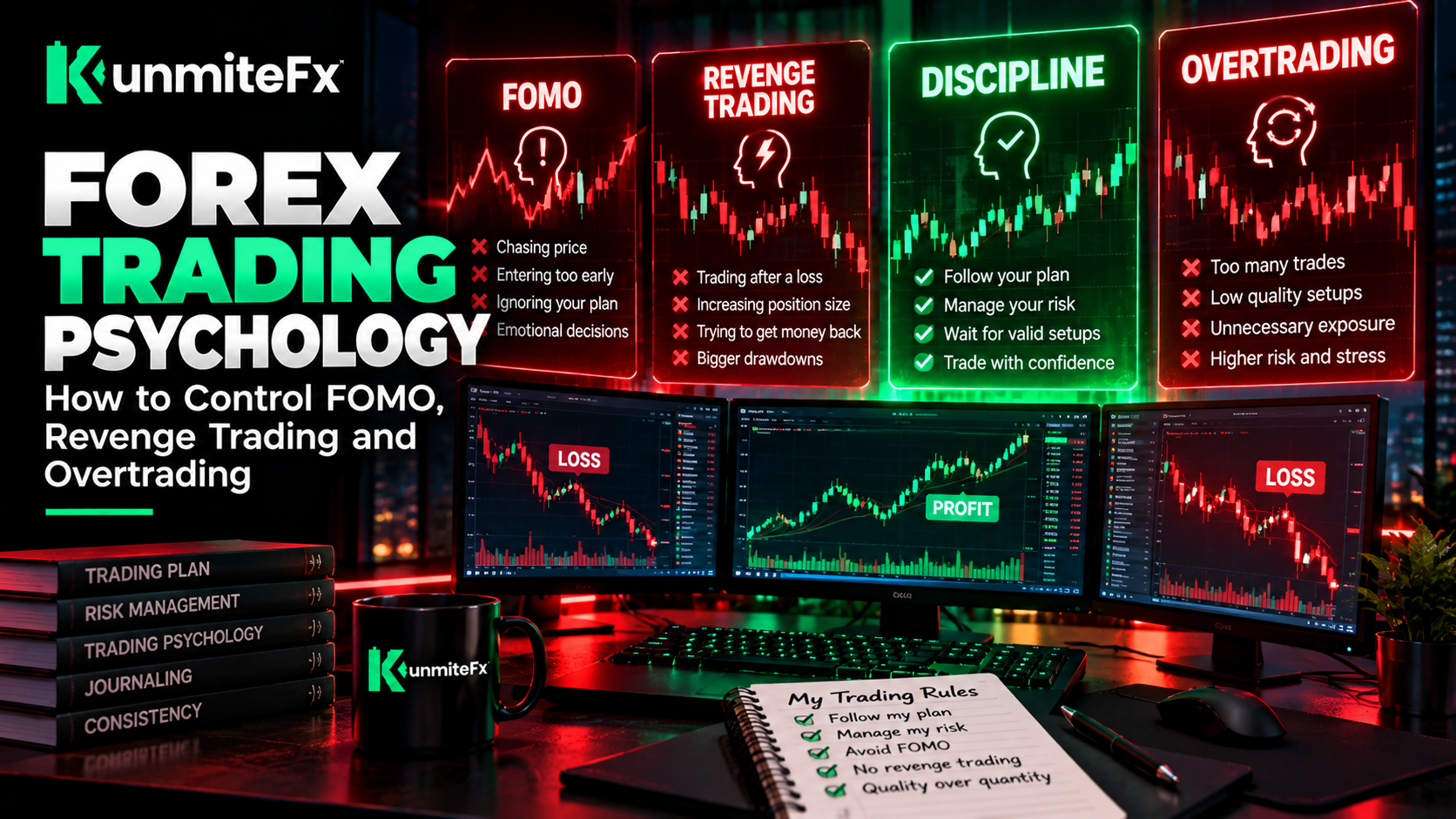
Forex Trading Psychology: How to Control FOMO, Revenge Trading and Overtrading
A trader can understand technical analysis, know how to calculate position size and have a clearly defined strategy—and still struggle to trade consistently.
Why?
Because trading is not only about charts.
It is also about decisions.
Fear, greed, frustration, impatience and overconfidence can influence how traders behave before, during and after a trade.
You may know that you should wait for confirmation but enter early because you are afraid of missing the move.
You may know your maximum risk but increase your position after a loss because you want the money back.
You may know that no setup exists but continue searching for trades because you feel that you need to be in the market.
This is where trading psychology becomes important.
The objective is not to eliminate emotion completely.
The objective is to build a process strong enough that emotions do not constantly change your decisions.
What Is Trading Psychology?
Trading psychology refers to the emotional and mental factors that influence trading decisions.
These can include:
Fear
Fear may cause a trader to avoid a valid setup, close a profitable trade too early or hesitate after several losses.
Greed
Greed may encourage excessive position sizes, unrealistic profit targets or staying in a trade long after the original plan said to exit.
Impatience
Impatience can lead to entering before the setup is complete or taking trades that do not meet the strategy.
Overconfidence
A winning streak can make a trader believe that normal risk rules no longer apply.
Frustration
A losing trade may create an urge to immediately enter another position to recover the money.
None of these emotions automatically makes someone a bad trader.
The problem begins when emotions repeatedly override a previously defined trading plan.
Why Trading Psychology Matters
Consider two traders using exactly the same strategy.
Both have the same:
entry rules
stop-loss rules
risk-to-reward requirements
position-sizing method
market analysis
Trader A follows the rules consistently.
Trader B changes position size after losses, exits winners early, moves stop losses and sometimes enters without confirmation.
Even though the strategy is identical, their results may be completely different.
The difference is execution.
A trading strategy only produces the results of the decisions actually taken.
That is why psychology and risk management are closely connected.
What Is FOMO in Forex Trading?
FOMO means:
Fear Of Missing Out
It occurs when a trader sees price moving quickly and becomes afraid that a profitable opportunity will disappear before they enter.
Imagine EUR/USD suddenly begins rising.
You planned to wait for price to return to a particular level before buying.
Instead, you see several strong bullish candles and think:
“If I don't enter now, I'm going to miss the whole move.”
You enter much higher than planned.
Shortly afterwards, price retraces.
You are now holding a position that you would never have entered according to your original strategy.
The problem was not the market.
The problem was allowing urgency to replace the trading plan.
Why FOMO Is So Powerful
Markets can move quickly, especially around major news events.
Watching price accelerate without you can create the impression that you are losing money simply because you are not participating.
But there is an important difference between:
missing a trade
and:
losing money
If you did not enter a trade, you did not lose money on that trade.
There will also be other market opportunities.
A trader who feels required to catch every move may eventually start chasing price.
How to Reduce FOMO
One effective way to reduce FOMO is to define your entry conditions before price reaches them.
For example:
You may decide that you only enter after a specific support or resistance reaction.
If price moves without producing your setup, the trade simply does not belong to your strategy.
You can record it and study it later.
This changes the question from:
“How do I get into this move?”
to:
“Did this move provide my setup?”
Those are very different questions.
What Is Revenge Trading?
Revenge trading occurs when a trader enters new positions primarily because they want to recover a previous loss.
Suppose you lose:
$100
You become frustrated.
Instead of waiting for the next valid setup, you immediately enter another trade.
You increase the lot size because you want to recover the $100 quickly.
That trade also loses.
Now you are down:
$250
The emotional pressure increases.
The next trade becomes even larger.
What began as one normal trading loss can become a serious drawdown.
Why Revenge Trading Is Dangerous
Revenge trading changes the purpose of the next trade.
Instead of asking:
“Does this setup satisfy my strategy?”
the trader begins asking:
“How can I get my money back?”
The market does not know how much you lost previously.
A losing trade does not make the next trade more likely to win.
When traders increase their risk simply because they lost money, they can turn ordinary losses into extraordinary ones.
This connects directly to our KunmiteFX lessons on risk per trade and drawdown control.
A Better Response to a Losing Trade
After a loss, the first task is not recovery.
The first task is determining whether the trade followed your plan.
A properly executed losing trade may not represent a mistake.
If your strategy has a 50% win rate, losses are expected.
The important questions are:
Was the entry valid?
Was the position size correct?
Was the stop placed according to the strategy?
Did you follow your rules?
If the answer is yes, the loss may simply be part of trading.
If the answer is no, the lesson should be identified before another trade is taken.
What Is Overtrading?
Overtrading occurs when someone takes more trades than their strategy or risk plan justifies.
It can happen for several reasons.
A trader may be bored.
They may want to recover losses.
They may feel confident after several winners.
They may believe that being active means being productive.
But more trades do not automatically create more profit.
If your strategy produces three high-quality setups in a week, taking another fifteen low-quality trades does not improve the strategy.
It may simply create unnecessary exposure.
Activity Is Not the Same as Productivity
This is an important concept.
Trading platforms make it extremely easy to:
enter a trade,
exit a trade,
increase a position,
switch markets,
and open another trade immediately.
That does not mean you need to constantly use those features.
In many professions, doing more work can produce more output.
Trading is different.
Sometimes the most disciplined action is:
doing nothing.
If your setup is not present, there may be no trade to take.
The Connection Between Overtrading and Leverage
Leverage can make overtrading particularly dangerous.
A trader may have enough available margin to open several positions.
That available buying power can create the impression that the account has room for more trades.
But available margin is not the same as acceptable risk.
Suppose you have four trades open.
Each risks:
1% of your account
Your combined planned exposure could potentially approach:
4%
If those positions are correlated, several may lose at approximately the same time.
This is why traders should consider total open risk, not just risk on an individual trade.
Overconfidence After Winning Trades
Psychological mistakes do not occur only after losses.
Winning can create problems too.
Suppose a trader wins five trades in a row.
They begin thinking:
“I'm reading the market perfectly.”
The next trade uses twice the normal position size.
Then the trader removes the stop because they are confident price will eventually reverse.
A winning streak has changed the trader's behaviour.
The strategy may not have changed at all.
This is why consistent risk rules are important during both losing and winning periods.
The Gambler's Fallacy
Another psychological trap occurs when traders believe that previous outcomes determine what must happen next.
For example:
“I've lost four trades in a row, so the next one has to win.”
It does not.
Or:
“I've won six trades, so I'm unstoppable.”
That is also dangerous.
Each trade should be evaluated according to its own setup and the statistical characteristics of the strategy.
A sequence of previous outcomes does not guarantee the result of the next trade.
Fear After a Losing Streak
The opposite problem can occur after several losses.
A trader may become afraid to take the next valid setup.
They spend hours waiting.
The setup appears.
Everything matches the strategy.
But they do not enter because the previous three trades lost.
The trade eventually wins.
Now frustration increases.
The trader then chases the next setup to compensate.
This creates a cycle:
Loss → Fear → Missed Trade → Frustration → FOMO → Poor Trade
A clear trading process can help interrupt that cycle.
Why a Trading Plan Matters
A trading plan moves important decisions away from the emotional moment.
Instead of deciding everything while price is moving, you establish rules in advance.
A useful trading plan should define your market, setup, entry conditions, invalidation point, maximum risk, position-sizing method, profit target and situations where you should not trade.
The more decisions that are defined before the trade, the fewer decisions need to be improvised under pressure.
Example: Emotional Trading vs Planned Trading
Imagine two traders both see a potential EUR/USD setup.
Emotional Trader
Price begins moving quickly.
The trader enters immediately.
No stop has been calculated.
The lot size is based on how confident the trader feels.
Price falls.
The trader moves the stop.
The loss becomes larger.
The trader immediately enters another trade.
Planned Trader
The trader waits for the predefined entry condition.
They identify where the setup becomes invalid.
They calculate position size.
They know the maximum amount that could be lost.
If the setup never appears, they do nothing.
If the stop is hit, the trade is recorded and reviewed.
The difference is not prediction.
It is process.
Use a Pre-Trade Checklist
A short checklist can reduce impulsive decisions.
Before entering, ask yourself:
Does this setup match my strategy?
Where is my stop loss?
How much of my account am I risking?
What position size matches that risk?
What is my profit target?
What is my risk-to-reward ratio?
Am I entering because of my strategy or because I am afraid of missing out?
Am I trying to recover a previous loss?
That final question can be particularly revealing.
Use a Trading Journal
A trading journal should record more than numbers.
Alongside entry, exit and profit or loss, consider recording how you felt before the trade.
For example:
Calm
Confident
Impatient
Frustrated
Afraid of missing out
Trying to recover a loss
Over time, patterns can become visible.
You might discover that many of your worst trades happen immediately after losses.
Or that you consistently increase position size after winning streaks.
Without a record, these behaviours can be difficult to identify.
Create a Maximum Daily Loss
One useful risk-control mechanism is establishing a point where you stop trading for the day.
For example, a trader may decide that after a predefined number of losing trades or a certain percentage loss, no additional trades will be taken that session.
The exact limit depends on the individual strategy and circumstances.
The principle is more important:
Do not allow frustration to create unlimited opportunities to continue losing.
A stopping rule can create distance between emotion and the next decision.
Take Breaks After Emotional Trades
If you notice that your heart rate is elevated, you are clicking quickly, increasing lot sizes or constantly switching charts, your decision-making may already be affected.
Closing the platform temporarily can sometimes be more useful than searching for another setup.
The market will still be there later.
You do not need to recover today's loss today.
Define What a Good Trade Means
Many traders define a good trade as:
a trade that makes money.
That definition creates problems.
Suppose you completely ignore your strategy, enter randomly and make $300.
Was that a good trade?
Financially, it made money.
But from a process perspective, it reinforced poor behaviour.
Now imagine you follow your strategy perfectly and lose $50.
Was that necessarily a bad trade?
Not if losses are expected within your strategy.
A healthier definition may be:
A good trade is a trade executed according to the trading plan.
Profit and loss should then be evaluated across a larger sample of trades.
Separate Outcome From Decision Quality
Trading contains uncertainty.
A good decision can produce a loss.
A poor decision can sometimes produce a profit.
If you judge every decision entirely by one outcome, it becomes difficult to build consistent behaviour.
Instead, evaluate both:
Was the decision correct according to my process?
and:
What was the financial outcome?
Over many trades, both matter.
Use Smaller Risk When Emotions Are Too Strong
If normal trading losses are causing extreme emotional reactions, your position size may be too large for your current comfort level.
Consider two traders.
Both lose 1%.
Trader A says:
“The trade followed my plan. I'll review it later.”
Trader B cannot sleep, immediately searches for another trade and feels desperate to recover.
The same percentage does not feel the same to every person.
Risk should be financially and psychologically manageable.
Do Not Use Trading to Solve Financial Pressure
Trading becomes particularly dangerous when the trader feels that they must make money.
For example:
“I need to make my rent this week.”
“I need to recover my debt.”
“I need this account to double quickly.”
These pressures can change how risk is perceived.
A normal stop loss begins to feel unacceptable because the trader feels they cannot afford another loss.
That can lead to larger positions, removed stops and forced trades.
Trading capital should not be money whose loss would create immediate financial hardship.
Build Consistency Before Increasing Risk
A trader should not increase position size merely because a few trades have gone well.
Before increasing risk, consider whether you have demonstrated consistent execution across a meaningful sample of trades.
Are you following your stops?
Are you respecting your risk limits?
Are you avoiding revenge trading?
Are you recording trades?
Are you following the same strategy?
Increasing capital exposure before improving execution simply magnifies inconsistent behaviour.
The KunmiteFX Trading Framework
Our previous articles focused heavily on the mathematical side of trading:
Position sizing
Risk-to-reward
Stop-loss placement
Leverage and margin
Risk per trade
Drawdown
Trading psychology connects all of them.
You can calculate the perfect position size and still ignore it.
You can choose a logical stop and still move it.
You can define a 1% maximum risk and still increase it after losing.
You can understand drawdown and still revenge trade.
Knowledge becomes useful only when it changes behaviour.
That is why a complete trading framework looks something like:
Trading Setup → Risk Plan → Position Size → Execution → Emotional Discipline → Review
A Simple Psychological Reset
When you feel an emotional reaction during trading, stop and ask:
What am I feeling?
Then ask:
What action does my trading plan require?
These two answers may be completely different.
You may feel:
“I need to enter now.”
Your plan may say:
“Wait for confirmation.”
You may feel:
“I need to recover my last loss.”
Your plan may say:
“Maximum number of trades reached.”
You may feel:
“This trade cannot lose.”
Your plan may say:
“Risk remains 1%.”
The plan provides a reference point when emotions are pushing you toward another decision.
Final Thoughts
Trading psychology is not about becoming emotionless.
That is unrealistic.
The goal is to prevent emotions from constantly rewriting your trading rules.
FOMO can make you chase markets.
Revenge trading can make you increase risk after losses.
Overtrading can create unnecessary exposure.
Overconfidence can make winning streaks dangerous.
Fear can prevent you from taking valid setups.
A structured trading process helps create consistency across all of these situations.
Remember:
You do not have to catch every move.
You do not have to recover every loss immediately.
You do not have to trade every day.
Your job is not to force the market to give you money.
Your job is to execute your process when the appropriate opportunity appears and manage your risk when it does.
Use the KunmiteFX Position Calculator to define your risk before entering a trade, and continue studying the KunmiteFX risk-management series to build a trading process based on structure rather than emotion.
Continue building your trading knowledge with KunmiteFX educational tools and resources.